Select a section
- PowerGuard® cables are intended for use in wet or dry locations for distribution of single or three phase medium- voltage power. These cables may be installed in ducts, exposed to sunlight or direct buried.
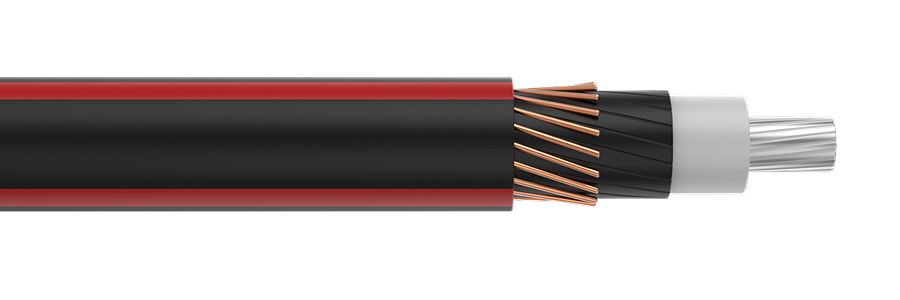
- Single conductor cable with filled strand copper conductors, true-triple extrusion, dry cured insulation system consisting of a thermosetting semiconducting conductor shield, high dielectric strength tree-retardant cross-linked polyethylene (TR-XLPE) insulation, thermosetting semiconducting insulation shield, copper concentric neutral wires, water blocking agents, black encapsulating cross-linked polyethylene (XLPE) jacket.
- Conductor:
- 1000 kcmil and Smaller - Compact stranded aluminum alloy 1350.
- Larger than 1000 kcmil - Compressed concentric stranded aluminum alloy 1350.
- Stranded conductors are water-blocked with conductor filling compound.
- Conductor Shield:
- Extruded thermosetting semiconducting cross-linked polyethylene (XLPE) shield which is free stripping from the conductor and bonded to the insulation.
- Insulation:
- Extruded, Tree-Retardant Cross-linked Polyethylene (TR-XLPE) - 100% insulation level.
- Insulation Shield:
- Extruded thermosetting semiconducting cross-linked polyethylene (XLPE) shield with controlled adhesion to the insulation providing the required balance between electrical integrity and ease of stripping.
- Metallic Shield:
- Solid bare annealed copper wires helically applied and uniformly spaced.
- Water-blocking agents:
- Applied over the insulation shield and around the concentric neutral wires to resist longitudinal water penetration. Longitudinal water penetration shall be tested in accordance with the latest edition of ICEA T-34-664 except that the minimum requirement is 15 psig for 1 hour.
- Outer jacket:
- An extruded-to-fill black non-conducting cross-linked polyethylene (XLPE) jacket, meeting the physical requirements of Table 1, when tested by the methods specified in ANSI/ICEA S-94-649. The jacket shall be free-stripping and not interfere with an intimate contact between the neutral wires and the underlying extruded insulation shield. The jacket is sunlight resistant and marked. The jacket shall contain a print legend marking, sequential length (meter or feet) marking and three longitudinal extruded red stripes.
| Table 1 |
|---|
| Physical Properties of Extruded-to-Fill XLPE Jacket |
| Unaged Tensile Strength, minimum (PSI) 1500 |
| Aged* Tensile Strength, minimum retention (%) 70 |
| Unaged Elongated, minimum (%) 150 |
| Aged* Elongated, minimum retention (%) 70 |
| Heat Distortion 1 hr at 131 ºC, maximum (%) 30 |
*Aged for 168 hrs at 121 ºC
- ASTM B496 – Compact Round Concentric-Lay-Stranded Copper Conductors
- ASTM B3 – Soft or Annealed Copper Wire
- ICEA S-94-649 – Concentric Neutral Cables Rated 5 Through 46 kV
- ICEA T-31-610 – Test Method for Conducting Longitudinal Water Penetration Resistance Tests on Blocked Conductors
- ICEA T-34-664 – Test Method for Conducting Longitudinal Water Penetration Resistance Tests on Longitudinal Water Blocked Cables
- ICEA P-45-482 – Short Circuit Performance of Metallic Shields and Sheaths on Insulated Cable
- AEIC CS8 – Extruded Dielectric, Shielded Power Cables Rated 5 Through 46 kV
- UL 1072 – Medium-Voltage Power Cables
- UL listed as Type MV-105 – File E476447
- Insulated Conductor and Shield Wire Temperature Ratings
- Normal: 105 ºC
- Emergency*: 140 ºC
- Short-Circuit – Insulated Conductor: 250 ºC
- Short-Circuit – Shield Wires: 350 ºC
- *Operation at the emergency overload temperature shall not exceed 1500 hours cumulative during the lifetime of the cable.